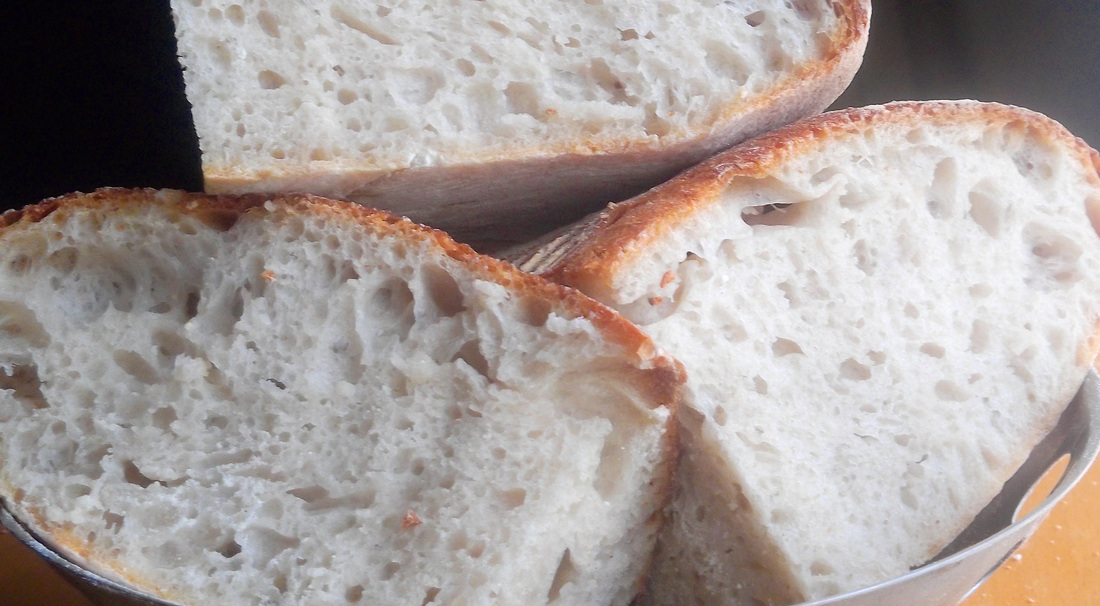
Behold! Behold my tangy crumb! Click to enlarge! BEHOLD THE CRUMB! DO IT!
I'm sorry, but really - crush my huckleberries in a vise and call me Abelard if that isn't just about there crumb-wise. Slightly sticky texture? Check. A sour tang? Check. I think this is probably the one, the recipe I'm going to stay with. I'm not sure I could do any better with the basic domestic oven I've got.

So what's different? Well, the weather, for one thing; and rather than the 60p a kilo supermarket flour of my last few attempts I went for a more expensive flour from Bambuni (Shipton Mill, I think), which I'm sure Huey will consider the absolutely crucial determinant; I'm now using a starter that I, erm, started from scratch; I'm also now using a proving basket and a peel (to transfer the dough onto the heated stone in the oven lickety-spit); but, really, I reckon it's mainly down to three factors:
  • I've ditched the overnight sponge palaver, my thinking being that maybe the length of time was causing the lack of the sour tang taste I was after.
  • I've upped the amount of starter added to the dough for the same reason, and also because I thought this might help achieve a wetter texture and larger holes in the crumb.
  • I've adopted Richard Bertinet's slapping/stretching method (see the video below) instead of a traditional kneading method or the 'just stretch and fold a few times' method.
There was a worrying moment when I  transferred the dough onto the stone and the little fucker just flumped. But then (as I watched anxiously through the oven glass door) it began, wonderfully, to rise.


It's been quite a while since I've done this - made a detailed record of every single thing I ate and drank during a week that is. For one thing, I know roughly how much I spend each week anyway, because it has to come out of a fixed weekly amount and, after several years of this malarkey, it seems I can now instinctively plan to buy, cook and eat at around the £40 mark. Also it is a fucking boring thing to do. But I thought it might be useful to blog about a whole week's worth of cooking and eating the 'skint foodie way'.

I planned the week's meals in advance (as I always do) then went out and bought the food (as I always do) and, yes indeedy, it came to just a few quid over the £40 target figure. But there are weeks when I spend under that, and weeks when I push the boat out a bit more. Only a few years ago my shopping list was a lot simpler to compile. It looked something like this:

    Day 1:      4 x cans of Tennent's Extra, 1 x 1 litre bottle of Glen's Vodka,
                    1 x steak pasty, 1 x bag of Quavers.
    Days 2-7: As Day 1.

Believe me, the present regimen is a significant improvement.

Before we go any further I'd like to emphasise something that should be obvious from the figure mentioned above of £40-ish a week: that this is not a blog about how to survive on the very lowest budget possible. It's more about eating good food, simply prepared, on a budget. There's a difference.

The difference can be seen, partly, by the presence here of things like scallops, smoked salmon, pancetta, steak and blueberries. But, while the cost of the scallops and pancetta (used in two dishes) came to £4.60, the smoked salmon was from a 90p/120g pack of trimmings from Asda, the blueberries were half price at the local Tesco Express and the 250g butler's steak (from the wonderful East London Steak Co.) cost £2.50.

Plus which, these few 'luxuries' were counterbalanced elsewhere by meals using split peas, rice, eggs and cheaper cuts of meat.

And, of course, everything I ate (with the exception of a handful of almond thins) was home-made - including breakfast cereal, bread, stock, desserts and cakes.

For the cost of each individual dish I have counted every ingredient, save for seasoning, herbs and spices (and I've made an overall allowance for these at the end). Anyway, here's the menu:
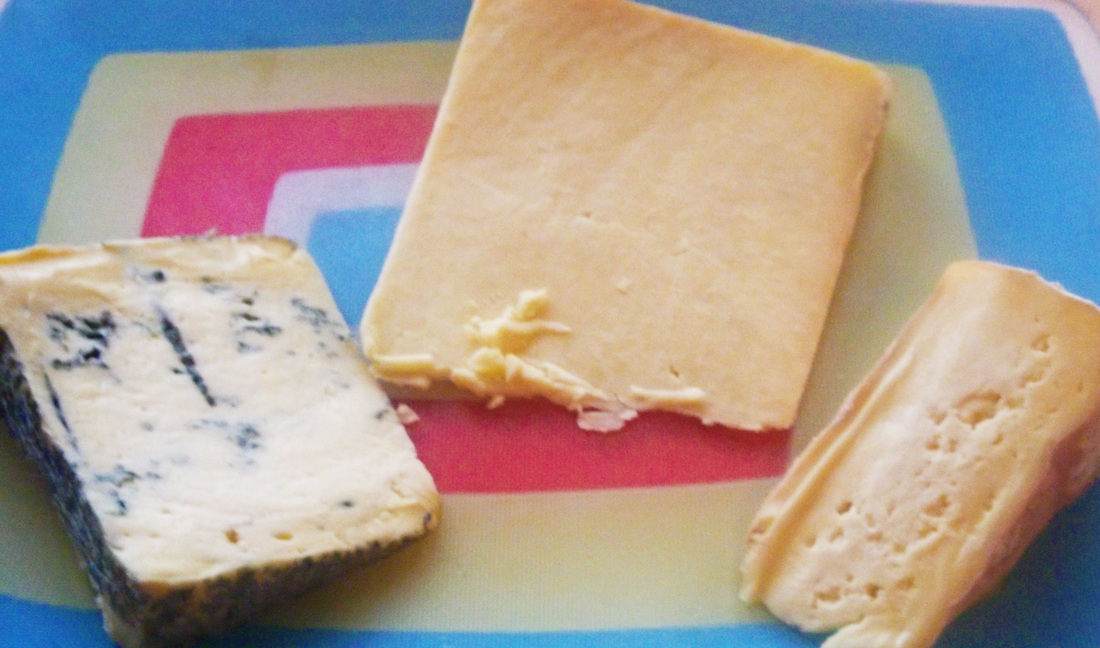
 
 
L: Cashel Blue (£1.70/100g); C: Kirkham's Lancashire (£1.76/100g);
R: Ardrahan (£2.20/100g)
And so time for another trip on the no. 177 to The Cheeseboard and the lactic delights contained therein. Pride of place on today's plate goes to a cheese from the fabled, mist-laden land of my ancestors - Mrs. Kirkham's Lancashire - flanked (above) by two beauties from Ireland. These three wedges cost £5.86.

I'm loving doing this little series of posts. It's not simply that I've been encouraged to try new cheeses (about a third of those presented thus far); it's more that sampling them with, and talking about them to, Robbyn has made me appreciate all the more the individual cheesemakers and their craft.

I like it that knowing about the clubbish exclusivity of the Grubb's herd of cows, or the particularities of traditional Lancashire production, or how the climate of Cork imparts its own unique quality to the taste of the Ardrahan adds immensely to our enjoyment of these cheeses.

Blessed be the cheesemakers.


My first attempt at a ciabatta.
One of the advantages of being an embittered, reclusive sociophobe, with nought but the Radio Times for companionship, is that you do have plenty of time for cooking - especially on a Bank Holiday weekend when the new meds have just started to kick in. Kitchen-wise it was so on this weekend at Skint House.

Apart from anything else, I was into days 3-5 of nurturing two new sourdough starters - a strong wholemeal one and a strong white one (the photos are of day 5).

On Saturday I found Richard Bertinet's ciabatta recipe here on this Canadian blog. I especially loved the part of the video where he shows how to stretch the dough prior to proving and thought 'hello, I fancy a bit of that!'.  And really, for a first attempt, it didn't turn out half bad.

On Sunday I picked up this bad boy for £1.99 and got 3 litres of glorious chicken stock out of it; and there were, of course, meals aplenty - and five of the recipes are included below.

But the great discovery for me this weekend was a cake that proved something of a hit at the inaugural meeting, last Wednesday evening, of the Band of Bakers - an informal gathering which provides 'for people in South East London who love baking to get together and share their latest creations over a few drinks'  The event was held at Bambuni. If you live in the SE15/SE22 area and haven't yet been to this cracking deli/coffee shop then shame on you. You can see what you're missing from these photos of the event. I didn't go myself (there's a strict lockdown policy in force here at Skint House) but word soon got around that a chap called Charlie had brought along a stunning rhubarb and ginger cake. Then, the very next day, he shared the recipe here on their blog. A grateful nation salutes you, big man.


I realised recently that it was getting a bit clumsy to have links to different recipe categories and then have to scroll down through a dozen or more recipes each time you wanted to find one particular dish.

So, now, each one of the 200 plus recipes has its own individual page, links to which can be found in the recipe index. I reckon that makes things a bit neater.


L: Rocamadour (£1.55 each 35g); C: Childwickbury (£6.95 each 200g round); R: Tomme Bluette Chevre (£2.30 per 100g)
A seasonally apt all goat's milk trio of cheeses this time around - springtime on a plate. For me, the star of the show was undoubtedly the Childwickbury - smooth, spreadable and milky, slightly lemon zesty, it's probably the cheese God uses on his bagels instead of Philadelphia.

You can't see it from the photo (I think they're on the underside) but there are a few blue veins on the chunk of Tomme Bluette - however, to taste, you'd hardly know it was a blue cheese at all (or, indeed, a chevre). I loved it as it was, but I'd be interested in trying it when more fully veined.

The Rocamadour was the only one of the three instantly identifiable as a goat's milk cheese, and had been perfectly aged. Its intensity made a nice contrast to the freshness of the Childwicksbury and the smoothness of the tomme.

This lot cost £7.55 - five pence over our imposed limit. But £3.50 of that was for the half portion of Childwickbury and it was so worth it. If the wedge of tomme had hit the scales at 100g, we'd have been fifteen pence under, so I think we can allow an overspend just this once.

The following notes are, as ever, courtesy of Robbyn Linden from The Cheeseboard, the corner (literally - see below) shop of my dreams.


I had something of a result this week. I'd budgeted a certain amount for the leccy bill and it turned out to be only half what I thought it was going to be. So I was able to push the boat out a bit foodstuff-wise.

And one of the treats I allowed myself was a kilo of glorious Gloucester Old Spot pork belly, courtesy of Marky Market, whom God preserve.

I thought that such a fine chunk of meat demanded to be cooked and served relatively unadorned, to be the star of the show. And it most certainly was. The layer of fat between the skin and the flesh was just the right thickness to flavour the meat (as opposed to some you get where the fat is the major element of the joint) and rendered off during the cooking to leave a slab of tender juicy meat. It wasn't cheap - £9 per kilo - compared to what you might find in a supermarket, but it was worth every penny.

I didn't fancy going the gravy and potatoes route particularly, so I came up with this salad as an accompaniment. It worked really well. I'll be making it again soon (minus the crackling) - it would, for example, make a superb partner for a plate of cheese.

I still fancied a small carb hit with the meal. There was some tomato sauce, heavy on the garlic, left over in the fridge, so I simply stirred in some cooked haricots and chopped parsley and drizzled over a little olive oil.

Verdict: the second result of the week.


The simplest of mid-week suppers, I had this last night with some cheese and fruit to follow.

serves one
one or two slice of serrano, roughly torn
a thick slice of pugliese or sourdough bread 
a splash of olive oil
a small garlic clove crushed
a pinch of chilli flakes
4 raw prawns, peeled (I leave the tails on, but it's up to you)
a pinch of black pepper
roughly chopped parsley

Toast your bread, ideally on a griddle. Fold on the roughly torn pieces of serrano.

Heat a small pan (I use a 20cm wok) to a fairly high heat and add a splash of olive oil. Throw in the garlic and chilli, then the prawns and add a pinch of pepper (no salt). Toss until the prawns are cooked through - a matter of moments.

Place the prawns on top of the ham, pour the pan juices over and around and scatter some parsley over.