
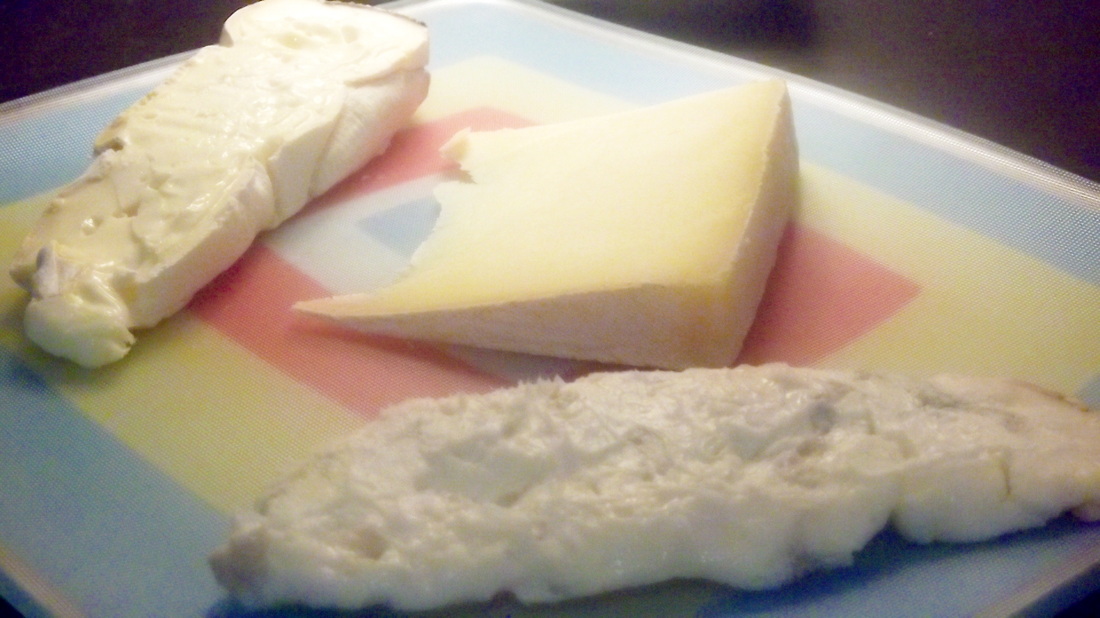
 Left: Mont d'Or (£2.52/100g) Centre: Wensleydale (£1.75/100g) Right: Gorgonzola Dolce (£1.75/100g) This post should really have gone out about two weeks ago, which is how long ago it was since, following my last visit to the Cheeseboard, the manager Robbyn (@CheeseboardUK) put together the notes below. The plan was that it would then qualify as February's cheese selection and I'd be on track to continue this monthly series in a timely fashion. Unfortunately, this otherwise excellent strategy failed to take into account the fact that I'm an indolent fucktard. Still, better late than never, what? The Mont d'Or is one of my favourite cheeses. It's also a rare example of enforced seasonality, in that its production ends this month (see below). I can't remember the last time I had any Wensleydale and I couldn't really say why that is. Perhaps something to do with memories of insipid supermarket offerings. But this Hawes Creamery cheese is a real star. The delightfully creamy Gorgonzola Dolce is the ideal cheese to offer someone who thinks they don't like blue cheese. I used most of this to make a stupendous pizza with ricotta, caramelised red onions, figs and a drizzle of balsamic dressing. The three portions of cheese in the photo above cost £5.95. Here are Robbyn's detailed notes: mont d'or (a.k.a. vacherin du haut doubs) Made from unpasteurised cow’s milk Cheese has been made in the Franche Comté since the 12th century. It was produced first in the great abbeys such as Saint-Claude and Montbenôit. Mont d'Or is a relatively recent addition to the local range of cheeses, having been made for a mere 200 years. Its making goes back to when the borders between countries were less defined and this had, until recently, led to arguments between France and Switzerland as to who had first made the cheese and who had rights over the name. In 1973 the Swiss acquired the legal rights to call theirs Vacherin du Mont d'Or. So the French now call their cheese (officially) Vacherin du Haut Doubs. But confusion still exists, with the French version still being referred to as simply Vacherin or Mont d'Or or Vacherin Mont d'Or. The Swiss version is made using pasteurised cows' milk, the French unpasteurised cows' milk - this is the French version. This seasonal superstar is produced from 15th August to 31st March. It must be made with unpasteurised milk from the cows of the Montbéliard and Simmentaler breeds. Most cheeses need meadowsweet summer milk in order to reach a significant level of flavour, but Mont d’Or achieves stunning flavour with winter milk for most of its season. Each cheese is secured into shape with a ring of spruce or fir tree bark which contributes to its distinctive slightly resinous flavour. It is ripened on a Spruce wood board, taking at least three weeks, and is rotated several times before it is placed in its characteristic wooden box. wensleydale Made from pasteurised cow’s milk Wensleydale has always been produced in the Yorkshire Dales. It was originally made by monks at Jervaulx Abbey, using sheep and goat’s milk. In the early 1900s there were hundreds of farms in the valleys and when the creamery at Hawes was set up in the 1930's, it was one of the first producers in England to collect milk from local farms and make cheese centrally. In order to accommodate large-scale production, Hawes tweaked the original recipe which resulted in a firmer style of Wensleydale cheese. Hawes Creamery was able to successfully produce cheese through both World Wars, which gave stability to the farmers from whom they purchased their milk. This was particularly crucial prior to the Milk Marketing Board forming in 1933. After the Milk Marketing Board was disbanded, Dairy Crest took over Hawes Creamery, but then moved Wensleydale production to Lancashire in 1992. Fortunately, the managers joined forces with the workers and other locals to purchase Hawes. The independent Hawes Creamery was set up in 1993 and has been making Wensleydale ever since. In recent years they have returned to making it in the traditional style and texture of Wensleydale. Unlike most cheese makers, Hawes make their own starter cultures, which impacts both the flavour and texture of the cheese. Hawes makes their Wensleydale with a lower acidity than many others, which gives it more depth of flavour. This particular Wensleydale is from Neal’s Yard Dairy for whom Hawes make a special cloth-bound cheese with traditional rennet and less starter. The limestone soil in the Dales gives the cheese a gentle flavour, which is balanced by an underlying tart freshness with a citrusy tang. The cheese is traditionally eaten with fruitcake or apple pie. gorgonzola dolce Made from pasteurised cow’s milk
Until the early part of the 20th Century, Gorgonzola Dolce was known as stracchino or stracchino verde. As it became more popular, the name was changed to Gorgonzola, after a local village outside Milan where the cheese was made. It is now Italy’s most famous blue veined cheese. Historically rennet was added to the evening milk and the curds were hung up to dry until the following morning. The curds were then put into a mould and layered with curds from the morning milk. Today, the cheese is made by heating the milk to 82°-93°F, then adding starter cultures, pencillium glaucum spores, and rennet. The curds are broken up and left undisturbed and then lifted out with hemp cloth and left to drip-dry for 12 hours. The cheese is then ripened for 5 to 6 days and turned each day. The cheese is salted by hand every other day for 3 weeks. The cheesemakers insert either copper or steel rods into the top and bottom of the cheese over the course of 4 to 5 days, this enables the mould to develop. The cheese is then aged for 20 to 30 days at which time it will have developed its immediately recognisable blue-green marbled colour. In 1996, Gorgonzola received Denomination of Protected Origin (DOP) certification. In order to comply, producers must use milk from cows raised in either Piedmont or Lombardy. This is a very young, creamy rich cheese, nothing like the stronger and harder Gorgonzola Piccante.
12 Comments
Sam Hambleton
5/3/2012 11:05:22
Lying in bed with a sickness bug, and I still want to eat cheese! Great descriptions.
Ed Morgan
13/3/2012 11:47:34
Agreed! Great descriptions - the sound of Wensleydale with fruitcake sounds like heaven. I once had tea bread with crumbly Lancashire cheese and it brought that food memory flooding back... 6/3/2012 01:00:39
Love the expression "an indolent fucktard"... made me smile!
The Skint Foodie
6/3/2012 01:57:45
I know what you mean re. Wensleydale. But this one stands above others I've tried, in the same way that Gorwydd stands above other caerphilly.
Dizzy Izzy
7/3/2012 08:01:15
Mmmmm - delish! My gums are watering! Have always been a fan of exceptionally ripe soft French cheese and Mont d'Or is up there in my top three (are you a fan of Epoisse fermier?). Could it eat with a spoon but normally use one of those exceptionally healthy looking Kargs crispbreads (commonly known as Kargs roof tiles in my house!) to feed face. Have always shied away from blue cheese but may well give the gorg dolce a whirl. Tks for whetting my taste buds - again.
The Skint Foodie
7/3/2012 12:00:21
Yep, I am a big fan of Epoisse!
Peter
9/3/2012 08:57:12
I see they've got the Mont 'or in waitrose. Just bought one. Nice and ripe, v tasty
Cathy
11/3/2012 08:17:15
dear Skint Foodie, thanks for your post, the cheeses look delicious. Wot do you eat them with, if I may ask (oatcakes, crackers, quince paste etc)? Also, any chance you could share your sourdough bread recipe? That loaf looked the business. And in fact I bet sourdough bread would be very nice with the cheeses.
Cathy
11/3/2012 09:34:30
PS I forgot to say I came across your blog via the Guardian. I think you are totally right both with your approach to food and with your thoughts on the fact that there are increasing numbers of people living on their own and feeding themelves and most food writers/celebrity chefs ignore that.
The Skint Foodie
11/3/2012 14:56:26
Hi Cathy. If the plate of cheese was going to be the centrepiece of a meal then I'd have a salad, a hunk of good bread and a bowl of fruit. If at the end of a meal then probably sourdough crispbread or crackers from The Fine Cheese Co. or Carr's. And maybe a ripe pear.
Elkie
13/3/2012 05:44:05
By chance i decided to have a look at your blog whilst eating my lunch; gorgonzola, a pear and apple. Yum. 23/4/2012 03:12:59
Loving the blog. Your comment will be posted after it is approved.
Leave a Reply. |

SHORTLISTED FOR FOOD BLOG OF THE YEAR 2014
follow/subscribe:
   blog archives:
November 2014
|
