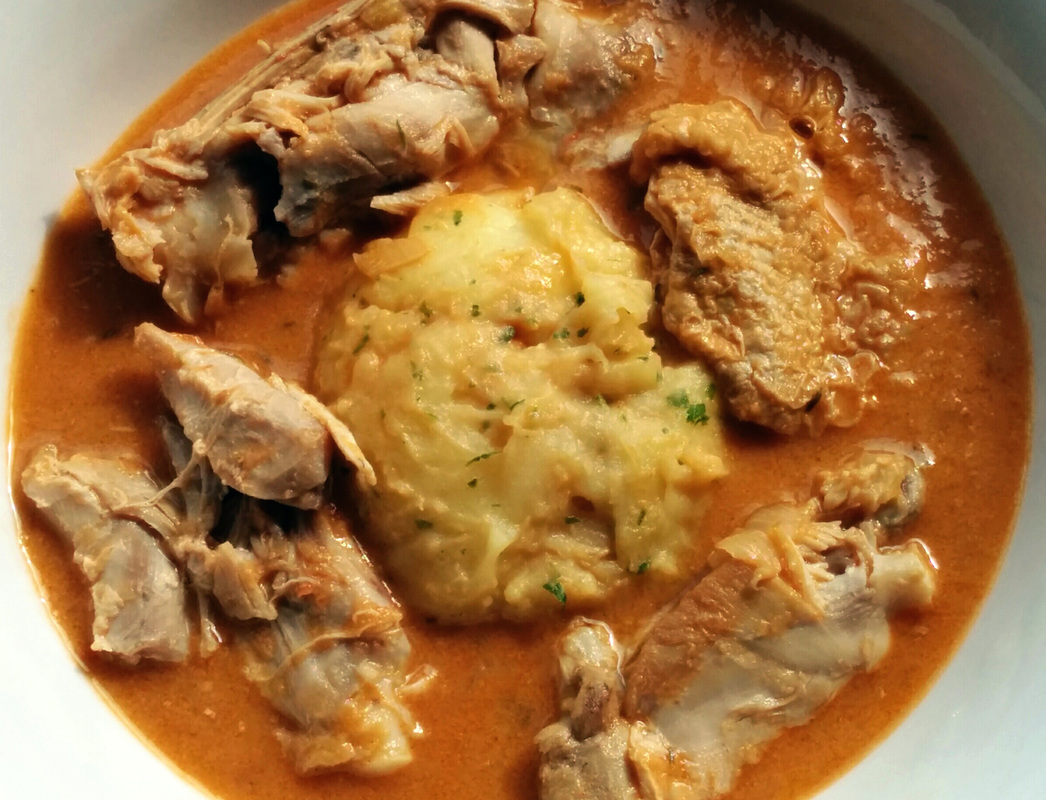
Sausages and mash Sausages and mash with onion gravy: words to stir an atavistic yearning in the hearts of all stout yeoman throughout this fair isle. And me. They're also words to be found on pub lunch menus beyond counting, a seemingly reassuring presence amongst all the Thai curries, lasagnes, burgers, pesto pastas (V), BBQ chicken wings, risottos, pies of the day et al. Sadly, however, what you tend to end up with gravy-wise is an unedifying, overly sweet, gloopy paste (see also 'French onion soup'). Neither, it must said, have I liked the stuff whenever I've tried to make it (once every couple of years). Until very recently. Until circumstances (the purchase of two majestic faggots from Flock & Herd a month or so back) forced me once again, heroically, to have another bash at it. Faggots and mashed swede And, fuck me, this time it was really delicious. I have to attribute my stunning success to the frankly inspired decision to include in the recipe these two beauties:
Marsala and Hendo's Now you might think Marsala to be an expensive indulgence; but this bottle, from Morrison's, was £4.49 for 375ml. So the 45ml called for in the recipe costs not quite 54p. More than reasonable for the price of success I think you'll agree. As a Lancashire lad I bow to the ancient foe in one respect only - Henderson's Relish is made there. Fair do's. If you haven't got any, use Lea & Perrins. I never make beef stock, do you? Probably not. I've no problem with using MPW's beloved Knorr stock pots. Well just the one - they are only a grain or two away from being too salty. I wish they'd make a no salt version. Still, they work here - but you won't need to add any more salt, just pepper. I almost always cook sausages by coating them in oil and then roasting in a 200C/180C fan oven for about half an hour, turning once or twice. You get a more even colour to them that way. the recipe
serves two a splash of vegetable oil 25g butter approx 300g red onions, thinly sliced 45ml marsala 300ml beef stock (made from a Knorr stock pot or similar) a good splash of Henderson's Relish (or Worcestershire sauce) black pepper
Splash a little oil into a large frying pan set over a low heat, add the butter and melt. Add the sliced onions and cook, stirring now and then, until they are meltingly soft and have taken on colour but are not burnt at all - I left mine for about 45 minutes.
Add the marsala and let it reduce to almost nothing. Now add the stock, a good splash of Hendo's and a couple of grinds of black pepper.
Bring the gravy to a low simmer and let it bubble away happily for half an hour or so (i.e. while you cook your sausages).
I was given a kilo bag of calasparra rice last Thursday (birthday gift, valentine's day - don't, I know, very fucking hilarious). The previous evening I'd written out the next week's menu (my 'week' tends to start on Thursday, because that's when the money comes in) which, dinner-wise, read: Thu: onglet + gratin dauphinois Fri: macaroni cheese Sat: sausages + peppers Sun: spaghetti + broccoli Mon: rice + chicken Tue: cod + lentils Wed: omelette + salad I had intended to use this recipe for the rice and chicken, but the gift of calasparra prompted a change of tack away from a risotto and more towards a kind of paella (and I've always got a chorizo sausage or two in the freezer and a tin of spanish paprika in the cupboard). Then at the weekend, as if by celestial decree, the Guardian featured a recipe for arroz con pollo y chorizo from the estimable Nieves Barragán Mohach, executive chef for Fino and Barrafina. Here's a lovely little (1 min 23 secs) film about Barrafina to make you ache with longing to go there NOW (or at least buy the book): But that dish, stupendously delicious and authentic no doubt, has sixteen ingredients and I wanted a midweek-simple kind of a recipe. Also, my home-made chicken stock was already flavoured with carrot, celery and bay (NBM uses water).
So here's the (also delicious) result, made with just these eight ingredients:
the recipe
serves two (or one greedy person)
1 chorizo cooking sausage (approx. 75g), in small chunks approx 180g chicken meat (thighs or breast), in bite-size chunks ½ onion, chopped 1 garlic clove, crushed 1 tsp thyme leaves ¼ tsp of Spanish sweet smoked paprika 100g paella rice 200ml chicken stock salt + black pepper
In a suitable pan, fry the chorizo over a low heat - so most of its oil leaches out into the pan by the time it's cooked. Remove with a slotted spoon onto a plate (not kitchen roll, because you'll want to pour back any juices that collect into the pan later). Increase the heat and fry the chicken pieces briefly. Remove these from the pan onto the same plate as the chorizo. Now add the onion to the pan and, after a minute or so, the garlic and thyme leaves. When the onion has softened, add the paprika, stir, add the rice and stir again. Pour in 200ml of chicken stock, and add back the chorizo, chicken and any juices. Bring to a simmer and cook over a low heat, covered, for about 20 minutes. After about 5 minutes season to taste and stir again. Stir a few more times while it's cooking to ensure the rice doesn't stick to the base of the pan. If all the stock has been absorbed before the rice is cooked (though this shouldn't happen) add a little water. The finished dish should be moist but not sloppy.
a fear of béchamel A minute or two ago I googled 'macaroni cheese' and got 22,300,000 results. Room for one more do you think?
I love the combination of pasta and cheese. One of my favourite quick suppers is spaghetti tossed in butter, a spoonful of cream and plent of grated parmesan and black pepper. But I have issues with most macaroni cheese recipes; well two issues to be precise.
Firstly, I have an irrational dislike of béchamel sauce. Not a phobia exactly (is there a word for a fear of this culinary wallpaper paste? Probably) but such that I find it difficult to make the stuff. No doubt this stems from some maternally inflicted childhood dinner trauma. Although I have no specific memory for this, I do remember her once force-feeding me butter beans until I spewed them all out again. Hancock: I thought my mother was a bad cook, but at least her gravy used to move about. Yours just sort of lies there and sets. Griselda: That's the goodness in it. Hancock: That's the half a pound of flour you put in it! - from Hancock's Half Hour: 'Sunday Afternoon At Home'
Secondly, a lot of versions of this dish are singularly lacking much in the way of one of the two main ingredients, viz cheese. And whatever you might think of the recipe below it certainly doesn't fail on that score. It is rammed with cheese. It is cheese-ageddon as far as the macaroni is concerned. But no more of a quantity than you might easily polish off from a cheeseboard at the end of a meal, or in a supper of welsh rarebit.
Speaking of the macaroni, I used cavatappi (a type of elbow macaroni) from Morrison's at 95p/500g (or two for £1.50):
Anyway, here's my version: rich, filling, comforting, simple: cheese, pasta and cream.
the recipe
serves one
1 litre water 1 dsp table salt 75g macaroni 50ml milk 150ml double cream 1 rounded tsp dijon mustard 15g pecorino, grated 40g mature cheddar, grated 50g gruyère, grated a splash or two of Henderson’s Relish (or Worcestershire Sauce) black pepper
Bring the water and salt to a boil in a large pan. Add the macaroni and boil until cooked but still firm (i.e. ‘al dente’).
When it's cooked, drain the pasta then rinse in cold water to stop the cooking process and wash the starch off (so the macaroni won't stick together).
In another pan, bring the milk and cream to a simmer. Add the dijon mustard and all three cheeses. Season with black pepper and stir constantly until the cheese has melted. Add a splash or two of Henderson’s (or Worcestershire) and stir.
Turn the cooked macaroni out onto some kitchen roll and pat dry. Mix it into the cheese sauce. You could have a little taste just to check for seasoning, but it really won't need any salt adding, . Leave in the pan for at least 10 minutes (so the pasta can soak up the flavour from the sauce) or until you're ready to finish off the dish. Transfer the mixture into a small baking dish, reserving two tablespoons of the sauce, cover the dish with foil and bake in a 180C/160C fan oven for 15 minutes. Remove from the oven, discard the foil, pour over the reserved sauce and place under a hot grill for a minute or so until the top is bubbling and golden (keep an eye on it all the while). A bowl of salad leaves with a mustardy dressing is all that's needed as an accompaniment.
dig that crazy mac 'n' cheese
Mise-en-place is the religion of all good line cooks. Do not fuck with a line cook’s ‘meez’ — meaning his set-up, his carefully arranged supplies of sea salt, rough-cracked pepper, softened butter, cooking oil, wine, backups, and so on.
That's from Anthony Bourdain's Kitchen Confidential. Unless the timings in a recipe allow for otherwise, I always like to have all the ingredients of a dish prepared and set-up before starting to cook. At no time is this more crucial than when making an omelette. At the risk of appearing condescendingly pedagogic can I ask: do you know how to make an omelette? Here's no less an authority than Michel Roux Sr cooking a perfect example in a matter of seconds:
This recipe is a riff on the simple cheese omelette that Elizabeth David used to eat at the restaurant Molière in Avignon, as immortalised in her marvellously evocative 1959 article 'An Omelette and a Glass of Wine' (which begins with a lovely tale of Gallic omelette obsession from before the first World War). Comté is a gruyère-like cheese from the Jura region of France; the creamier, unpasteurised Beaufort would be superb here too. Otherwise, of course, just use Gruyère. Whenever I've previously made this, I'd oven bake the croutons in a little groundnut oil (olive oil would be too overpowering for this recipe). But I happened to have a spoonful or two of leftover chicken fat, used it instead, and the result was glorious. If you've got a jar of goose fat left over from Christmas I reckon that would make for a fabulous crouton too. the recipe
serves one 3 eggs 1 tbsp finely chopped chives salt + black pepper a knob of butter 3 tbsps finely grated comté 1 tbsp double cream a small handful of tiny sourdough croutons
If you keep your eggs in the fridge, remove and allow them to come to room temperature. Crack them into a bowl, add the chives, a pinch of salt and a good grind of pepper and whisk briefly with a fork. Get a small (about 200mm in diameter) non-stick frying pan nice and hot. Add the butter and allow to melt and froth, then pour in the eggs and cook as per the video above. When the omelette has barely set (the point in the video where M. Roux says "I like my omelette a little runny in the middle"), scatter the cheese all over it, then pour on the cream and then strew with the croutons. Fold and tip onto a plate and serve immediately, accompanied perhaps with nothing more than a salad of lightly dressed cos or romaine leaves.
I have something of an obsession with neatness. It's not merely tidiness and order, although those are included (I have to, for instance, open programs on my laptop in a specific order so they appear on the task bar from left to right thus: Thunderbird, Firefox, Spotify, then anything else - but Word has to be to the left of Excel). It's more about rightness, about the elegance of design exhibited when things are 'just so'. And, of course, this fixation extends to food. I'm not talking about artful presentation on the plate, I'm talking about, for example, why I find the flawed design of celery so intensely irritating. And why a recipe that calls for either just egg whites or yolks sends me bat-shit crazy. What the fuck are you supposed to do with the leftover yolks/whites (delete as appropriate)? Imagine then how happy the combination of these two recipes makes me - the whites used in the first, the yolks in the second. The stars are in alignment, God is in His heaven, and all is right with the world. It also takes care of my fondness for something sweet to end the evening meal with for the next two weeks.Can I get an 'AMEN'? little almond cakes
Moreish and toothsome delights.
makes 20 little cakes 3 egg whites 125g caster sugar 30g plain flour 100g ground almonds 100g melted butter 75g raisins icing sugar for dusting
Whisk the egg whites and caster sugar together until frothy, but not stiff. Beat in the flour, then the ground almonds, then the melted butter. Fold the raisins into the mixture.
Grease twenty of the holes of a 24 hole non-stick mini muffin tray with a little melted butter and spoon the mixture into them. Bake in the oven at 190C/170C fan for about 18-20 minutes - I'd start checking them after 15. Remove from the oven, dust with icing sugar and allow to cool before removing from the tray - they'll pop out without any trouble.
elderflower burnt cream
The classic flavouring for burnt cream (A.K.A. crème brûlée) is vanilla - add the seeds and the pod to the cream as it heats - but I didn't have any. I've always got a bottle of elderflower cordial though (Bottle Green ideally), and I now think I prefer it to vanilla for this - it adds a delicate, fresh note to the burnt cream.
makes enough for 4 x 100ml ramekins 3 egg yolks 20g caster sugar 250ml double cream 2 tbsps milk (or 3 tbsps if your cream is especially thick) 3 tbsps elderflower cordial 4 heaped tsps of demerara sugar for the 'burnt' topping
Heat your oven to 150C/130 fan. In a bowl, whisk the egg yolks and caster sugar together. In a small pan, heat the cream, milk and cordial, stirring the while, until just about to simmer. Remove from the heat and pour into the egg/sugar, whisking all the time.
Place four ramekins in a roasting tray and pour the custard into them. Open the oven door, slide the tray onto the middle shelf, and then pour cold water into the tray until it comes about halfway up the sides of the ramekins. Close the oven door and bake for 40 minutes. Remove from the oven and allow to cool completely, then chill in the fridge for an hour or so.
When you are ready to serve them, heat your grill to blistering hot, sprinkle the tops with the demerara sugar and slide the ramekins under the grill for a minute or so. Keep watching and remove the moment the tops are nicely golden and blistered (even better, if you have one, use a blow torch). Allow time for them to cool (and the burnt sugar to form a brittle shell) before scoffing.
I had some dill left over from having made this soup the other day and it's impossible to have dill in the kitchen without thinking at some point of gravad lax; this salad is, therefore, a kind of riff on that classic dish and its traditional accompaniment of dill and mustard sauce. I roasted a little piece of salmon, but you could just as well poach or sauté it, or even buy one of those little packets of ready cooked salmon from the supermarket.I wouldn't be tempted to use olive oil in the dressing - you want something neutral.serves one
for the salad: 125g cooked salmon, flaked 125g cooked new potatoes, quartered 50mm piece of cucumber, cut into large dice ¼ small red onion, thinly sliced 1 hard-boiled egg a handful of salad leaves¼ of a lemonfor the dressing: 3 tbsps groundnut oil 1 dsp white wine vinegar 1 dsp dijon mustard 1 tsp acacia honey salt + black pepper1 dsp of finely chopped dillTo make the dressing: in a small bowl, whisk together everything except the dill and taste for seasoning/sweetness. Now add the dill and briefly whisk. In another bowl, combine the salmon, potatoes, cucumber and onion; pour the dressing over and mix gently .Separate the white of the egg from the yolk. Finely grate the white and crumble the yolk. Place a handful of salad leaves on a plate. Spoon over the salmon/potato mixture. Finally, scatter over the crumbled/grated egg, squeeze the juice from the lemon quarter over the salad and serve.
I shocked myself today. No, smart arse, not by standing on the scales or looking in the mirror - although that's just reminded me of the lovely moment in the 1968 movie Targets when Boris Karloff looks in the mirror and scares himself - it was because I was looking through the recipe archive and found that I hadn't ever included this humble but scrumptious offering. I think the reason is that it's one of those recipes I've never thought to write down, just something I have made regularly for ages. Is it a salad? Well, I eat it when it's either tepid or at room temperature, and it has a dressing (made in the pan rather than separately) so I suppose so. I'll most often have this with a fried egg on top or (if you want to get fancy) an oeuf mollet (using the method described on this page). serves one 1 medium floury potato, in chunks a handful of broccoli florets (about the same volume as the amount of potato chunks) a splash of olive oil 1 sausage of cooking chorizo, in small chunks 1 garlic clove, finely chopped ½ onion, thinly sliced 1 ripe tomato, chopped 1 dsp capers, rinsed a blob of dijon mustard a good splash of red wine vinegar. salt and black pepperCook the potato chunks in boiling water for 5 minutes and drain. Steam or blanch the broccoli florets for a minute or so and drain. Add a splash of olive oil and the chorizo chunks to a frying pan over a low heat, turning now and again. After about five minutes, the chorizo will have released all its lovely paprika-stained oil into the pan. Remove the chorizo with a slotted spoon. Increase the heat a little bit and fry the garlic and onion until softened. Now add the potato chunks and fry gently until just cooked. Add the broccoli florets and cook until they're taking on a bit of colour. Now add the tomato, capers, mustard and vinegar and give everything a good stir. Allow a minute for the tomato to soften. Season to taste (remembering the chorizo and capers will be quite salty), remove from the heat and allow to cool.
I wouldn't normally bother writing about a cobbled together salad, but I really like this dressing I came up with and thought it worth a quick post.
On the other side of Rye Lane to the main entrance to Peckham Rye station, there's a little alleyway running alongside the railway bridge. Walk around the fruit and veg stall there and you'll find this place:
A nation rejoices Saturday the 7th of January 2012: a date that some cultural historians are already suggesting be ranked alongside such culinary landmarks as the publication of Elizabeth David's 'A Book of Mediterranean Food', the opening of the River Café, and the launch of Asda's 'Alex James Presents' range of cheeses. For it was on the morning of that very day, dear reader, that I published my first ever blog post. While it's still probably a little too soon for any talk of a campaign to establish a national holiday, I hope that you'll allow me, meanwhile, to indulge in a moment or two of reflection. I apologise for the vulgarity and presumption. To quote P. G. Wodehouse: It was one of the worst speeches I ever heard. The Adams woman told us for an hour how she came to write her beastly book, when a simple apology was all that was required.
If one or two skint people fancy a roast, they could be forgiven for assuming that beef is not an option; and, certainly, a hulking great joint of rib of beef (at £20 plus per kilo) is out of the question. In the past I've opted for a small joint of either rolled topside or silverside if I can get a small enough cut. From now on though, this will be my choice. In September of last year Peckham got a wonderful new butchery - Flock & Herd. The owner is Charlie Shaw - who formerly worked at Mettricks of Glossop, Drings of Greenwich and the Ginger Pig. A few weeks back, he introduced me to tri-tip - which I'd never had before. An expertly trimmed cut cost me just £6.07 for approximately 800g. What in the wide, wide world of butchery, I hear you cry as one, is tri-tip? Well, to quote another alumnus of The Ginger Pig, Nathan Mills of The Butchery Ltd:
|