
coffee: how to make a pretty decent cup at home
The last time I checked, a can of Red Bull cost £1.19. A double espresso made at home from a single estate coffee processed at the Jirmiwachu mill in the small Oromian town of Tore about 30 km south of Yirga Cheffe in Ethiopia will set you back 40p. Great coffee is such an affordable item.
I am very, very far from being any kind of an expert in coffee. The coffee industry - producing, importing, roasting and serving - is every bit as complex as that of the wine industry, perhaps more so. I recently read an article about Shaun Young, the UK AeroPress champion (yes, there is such a thing). He weighed out 17g of beans to grind in a Mahlkonig Tanzania grinder (£1,530) at a grind setting of 5.25, then used 15.5g to make a coffee with water at a temperature of 85°C. 85 degrees is (as I'm sure you all know) a temperature that works well for Columbian coffee. If he had been brewing Ethiopian he would have used a temperature of 92 degrees. Obviously.
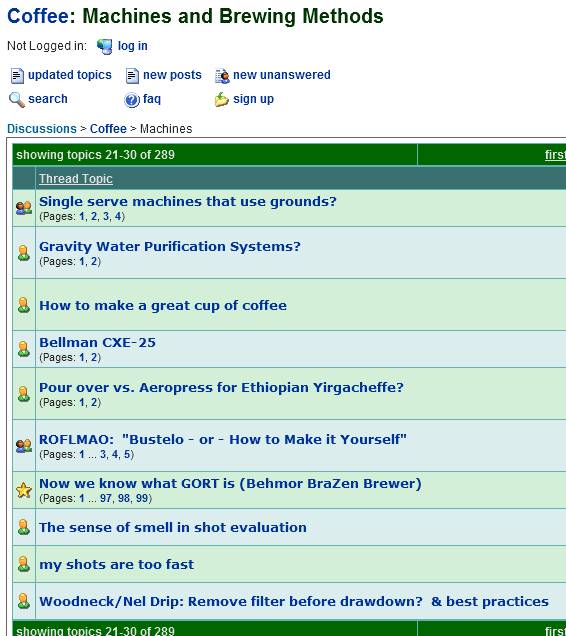
And beware, if you of an obsessive nature, of the forums on CoffeeGeek - you may never find your way out of there:
I am very, very far from being any kind of an expert in coffee. The coffee industry - producing, importing, roasting and serving - is every bit as complex as that of the wine industry, perhaps more so. I recently read an article about Shaun Young, the UK AeroPress champion (yes, there is such a thing). He weighed out 17g of beans to grind in a Mahlkonig Tanzania grinder (£1,530) at a grind setting of 5.25, then used 15.5g to make a coffee with water at a temperature of 85°C. 85 degrees is (as I'm sure you all know) a temperature that works well for Columbian coffee. If he had been brewing Ethiopian he would have used a temperature of 92 degrees. Obviously.
And beware, if you of an obsessive nature, of the forums on CoffeeGeek - you may never find your way out of there:
But for those of us with no great knowledge or expertise, if we can find a good roaster, and we take a little care in the brewing process, we'll be satisfied :
beans
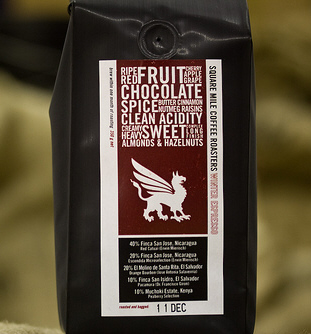
My God but there's some superb roasters out there these days: in my neck of the woods alone, we've got Volcano and Dark Fluid.
Then of course there's the peerless Square Mile, Monmouth, Workshop, and Nude Espresso, to name but a few.
For very reasonable online prices have a look at the deservedly popular Has Bean site. Lately though, I've been buying from Monsoon Estates - great coffee and (crucially for me) if you buy four bags you get delivery free.
With all of these suppliers you'll be buying coffee that has been roasted only a day or so beforehand (with the roasting date on the packet) - an important consideration.
But if all the above are beyond your budget, and you've got a Caffè Nero in your neighbourhood, they'll sell you 2 x 250g bags of their Classico blend for £5.50. It's alright.
Then of course there's the peerless Square Mile, Monmouth, Workshop, and Nude Espresso, to name but a few.
For very reasonable online prices have a look at the deservedly popular Has Bean site. Lately though, I've been buying from Monsoon Estates - great coffee and (crucially for me) if you buy four bags you get delivery free.
With all of these suppliers you'll be buying coffee that has been roasted only a day or so beforehand (with the roasting date on the packet) - an important consideration.
But if all the above are beyond your budget, and you've got a Caffè Nero in your neighbourhood, they'll sell you 2 x 250g bags of their Classico blend for £5.50. It's alright.
grinding
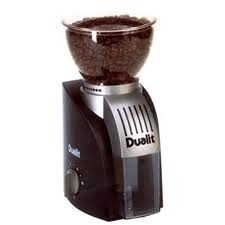
Unless you've got one of these bad boys (I have), I'd get the coffee shop to grind for you. It's a burr grinder. Blade grinders don't actually grind the beans, they decimate them. These actually do grind, so you have a uniform grain with the oils and flavour intact.
Otherwise, tell the shop what machine you're using to make your coffee and they'll grind the beans accordingly.
Buy small quantities to ensure freshness and keep away from excessive air, moisture, heat, and light. In other words in an air-tight container in the cupboard. Don't refrigerate or freeze the beans.
Otherwise, tell the shop what machine you're using to make your coffee and they'll grind the beans accordingly.
Buy small quantities to ensure freshness and keep away from excessive air, moisture, heat, and light. In other words in an air-tight container in the cupboard. Don't refrigerate or freeze the beans.
what to make it with
There's rather a lot of ways to brew coffee at home. Has Bean, on their website, have brewing guides for: AeroPress, Chemex, Eva Solo, French Press, Kalita Kantan, Kalita Wave (a rival to the Hario V60) and Vac-Pot/Syphon.
The AeroPress coffee maker has been around since 2005 and many, many people (both baristas and people without beards) rave about it. As you can see in this demo from Gwilym Davies, it has the most brilliant way to dispose of the coffee grounds:
The AeroPress coffee maker has been around since 2005 and many, many people (both baristas and people without beards) rave about it. As you can see in this demo from Gwilym Davies, it has the most brilliant way to dispose of the coffee grounds:
But given that you could buy them both for the price of one AeroPress, I'd be tempted to go for a 3-cup Moka Express from Bialetti together with a Hario plastic V60. Note, though, that you can't use the standard aluminium Moka on an induction hob.
milk
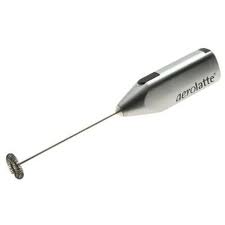
If you're making a cappucino-flat-white-cortado-piccolo-latte-type cup of coffee, what you want to try and aim for is microfoam - a pourable, liquid foam with the bubbles hardly visible - as opposed to 'dry' foam which has separated from the liquid. Making a proper microfoam is a barista skill, but you can get a sort-of home kitchen approximation with a milk frother. Warm your (full-fat) milk in the microwave or in a pan to no more than 70C (above that the protein curdles) and froth. Use two jugs in which to pour the milk back and forth a few times, in order to incorporate the bubbles into the liquid. Tap the jug onto your work surface a few times to pop any visible bubbles on the surface of the milk and give it a good swirl before pouring into your coffee.
If you're making a cappuccino, what you are most definitely not after is something like those monstrosities sold by the chains - a bucket of milk with a waiter standing by the side singing the Coffee Song. Rather wonderfully, Italy now has an officially certified recipe for a cappuccino:
"It should be made with 25ml espresso and 125ml frothed milk. 100ml of cold (3-5C) fresh milk with at least 3.2% protein and 3.5% fat content must be frothed to 125ml, reaching a temperature of 55C. It then needs to be poured over 25ml certified Italian espresso in a white 160ml cup."
Bless 'em.
If you're making a cappuccino, what you are most definitely not after is something like those monstrosities sold by the chains - a bucket of milk with a waiter standing by the side singing the Coffee Song. Rather wonderfully, Italy now has an officially certified recipe for a cappuccino:
"It should be made with 25ml espresso and 125ml frothed milk. 100ml of cold (3-5C) fresh milk with at least 3.2% protein and 3.5% fat content must be frothed to 125ml, reaching a temperature of 55C. It then needs to be poured over 25ml certified Italian espresso in a white 160ml cup."
Bless 'em.
water
What's the tap water like round your way? You might want to seriously consider using mineral water to make your coffee. Especially after you've read this article from Chloë Callow.
