
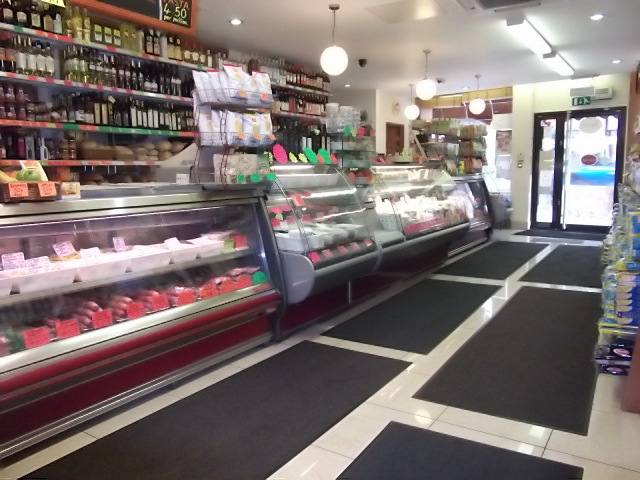
 ‘The first thing you noticed as you went into Gazzano's…was the smell, perfume rather – the sweet savour of cured pork overlaid by the clean, lactic tang of cheese and the heady blast of coffee…Gazzano's, founded by Joe's family a century ago, was a model of its kind, shelves piled with rustling bags of pasta asciutta, dried pasta, ranks of bottles and tins of olive oil and carefully selected wines. It cheered you up just going in there, browsing over the display cabinet of salamis speckled with fat and peppercorns, legs of prosciutto or rolls of porchetta ready to be carved, and mortadellas as round as cannon barrels. There was an array of cheeses, laid out with artful casualness, and neat tumps of sausages, glistening and tied to each other with string. Around the corner were the fresh pastas, raviolis with two or three different fillings (the pumpkin was a particular favourite of mine) and agnolotti, tagliatelle.' That description, from Matthew Fort's tender 2010 obituary of Joe Gazzano Sr ('a modest, kindly man') is of the shop before the 2004 development of the site; but though the layout has changed, the exalting delight you feel on entering this legendary salumeria remains exactly the same. Not that the utilitarian architecture of the building (see below) gives much hint of the wonders that lie within. You could easily miss it as you stare out of the window of the 63 bus (and the 63 bus it will be, because that's the only one that passes here; how fortunate then that its route takes it along Rye Lane, Peckham, meaning I've a journey time of no more than 30 minutes to get here). But pass under that awning and you step into 'Italy in a shop'. 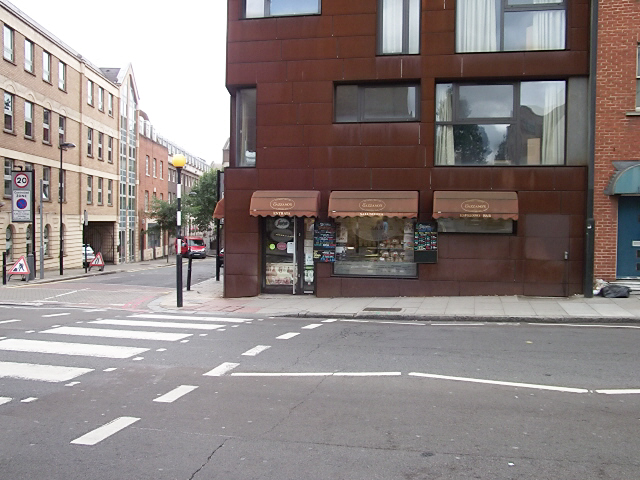 The Gazzano's has a fascinating history. Joe and Lucy, Joe Sr's son and daughter, are the fourth generation of the family to run the business. Until I talked to Joe the other day I believed, as did Matthew Fort obviously, that there had been a Gazzano's here for over a century - I mentioned 1903 as a date I thought I'd read somewhere. But Joe told me that his great-grandfather, Alfonso Mariani, the founder of the shop, would only have been about 14 at that time and that he actually opened it in 1921. Arriving here from his birthplace of Minori, a town on the Amalfi coast in the south of Italy, a few years earlier, by 1921 Alfonso had saved enough money to buy the site and build a shop - A. Mariani Stores. At the heart of what was then a populous and vibrant Italian working class community - London's 'Italian Quarter' or 'Little Italy' - the business flourished from the outset. Two years before World War II broke out, an olive oil salesman from Liguria, Giuseppe Gazzano, arrived on the scene and before long was courting Alfonso's daughter, Iolanda. On the 10th of June 1940 Mussolini declared war against Britain; there were then some 19,000 Italians in the UK. That very same day, Churchill issued the order to "collar the lot". Internment was, in many cases, followed by deportation to Canada and Australia. Giuseppe was due to be transported on the elegant Blue Star liner The Arandora Star. At the last minute he met a fellow Italian who was distraught – he had been separated from his son, who was on the Arandora while he, the father, was down to board another ship. He and Giuseppe swapped places. The day after the Arandora Star left port, it was torpedoed and sunk by a German U-boat. 805 people lost their lives. The ship that Giuseppe was on arrived at its destination without incident. Returning to London after the war, Giuseppe married Iolanda and in 1949 a son was born – another Giuseppe. In 1952, the Gazzano’s took over the business from Alfonso and the store became Gazzano and Son. In 1974, Giuseppe (Joe) the son took over. During the course of the next three decades the business went from strength to strength. In 2004, Joe had the opportunity to rebuild his shop during a site redevelopment. In 2006, the new, expanded store was re-named The Gazzano’s. But enough of the history lesson, let's move on to a look at the dazzling array of vittles on display. On your right as you enter the shop, you'll find a couple of chiller cabinets packed with salume of all kinds... 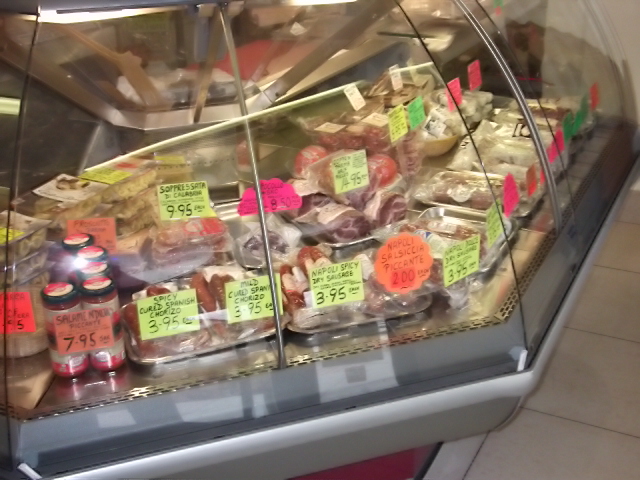 ... and here's a list of just a few: Magretto di Lombo, Porchetta, Fiocco di prosciutto, Casalingo Toscano, Finocchiona, Spianata Calabrese, Ventriciana, Pancetta Coppata, Soppressata di calabria, Capocollo Umbro, Salame Norcinetto, Salame di Cinghale, Lardo, N'Duja. 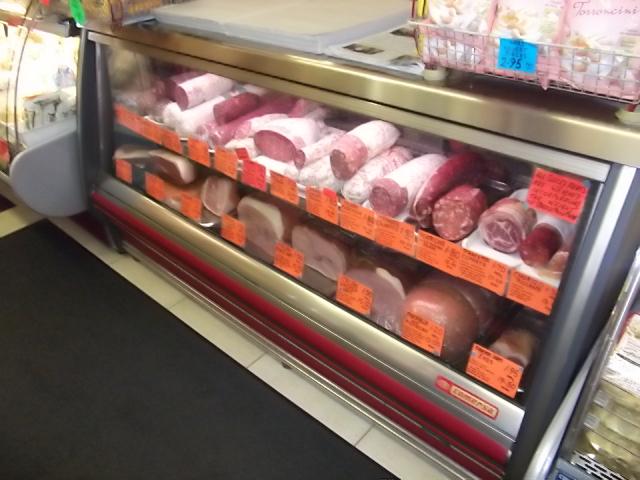 Next along are the cheeses... 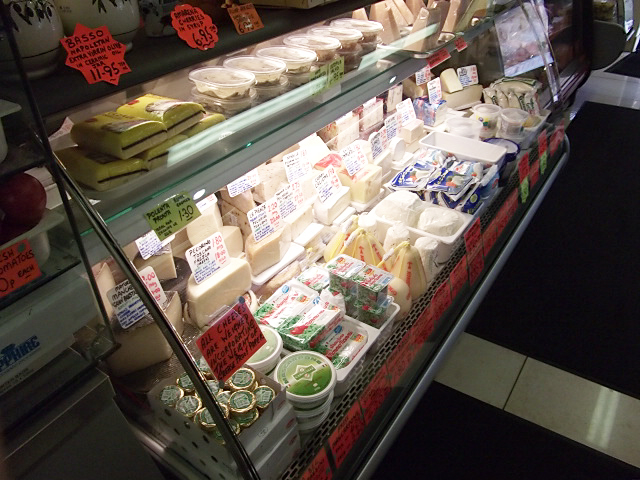 ...including such delights as Giglio Sardo, Rigatello, 9 different pecorinos, 3 types of provolone, Caciotta, Capretto Sardo, Asiago and Burrata. 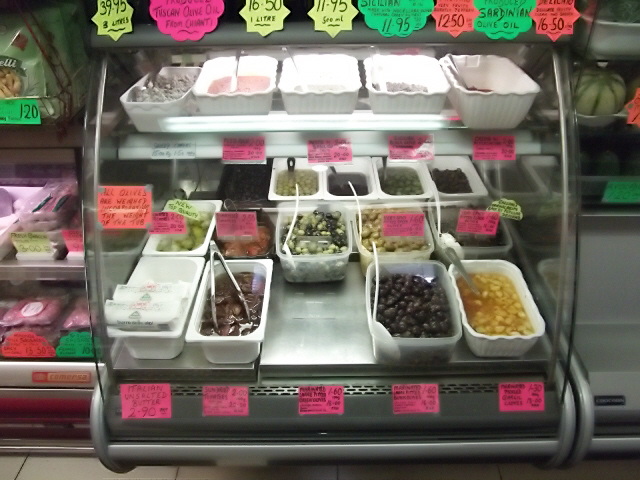 Then a cabinet of olives, marinated vegetables, salted capers, tapenade and pestos - including a pesto rosso and Crema di Pepperoncino (made with Sicilian red chillies). Next up are the fresh pastas - gnocchi, raviolinoi, ravioli, tortellini, tortelli (artichoke, gorgonzola and walnut, pumpkin) and Nodini d'Amore (made with truffle).... 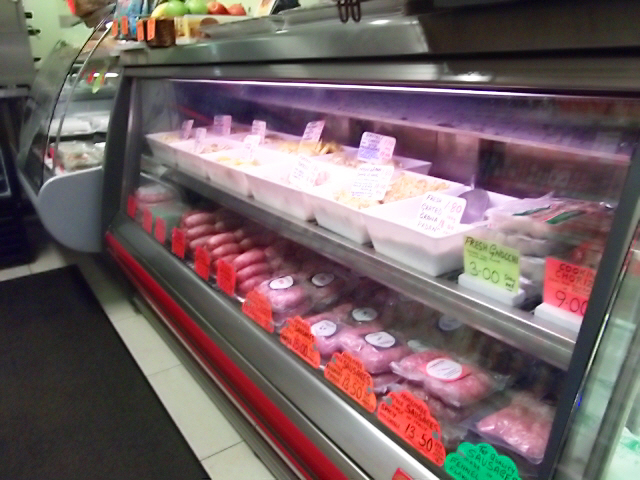 ... and the salsicce - Luganega, Salamini, Genovese, Napoli, Tuscan, truffle, chilli etc. Finally, a small selection from their menu of takeaway food. 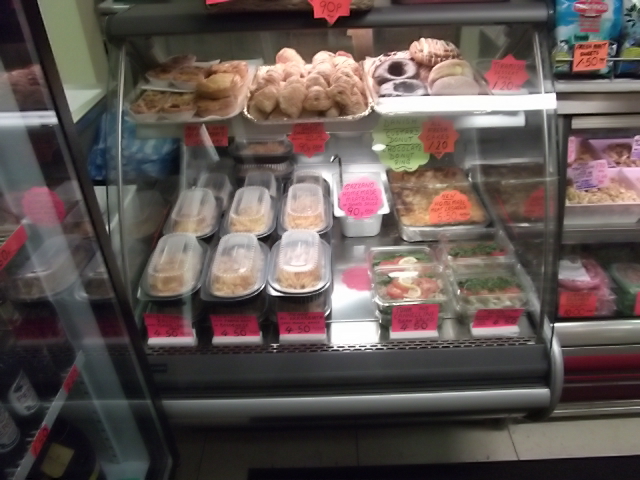 At the rear of the shop is a chiller unit of cold drinks (naturally sparkling water for 60p) and a vast choice of bottles, jars,... 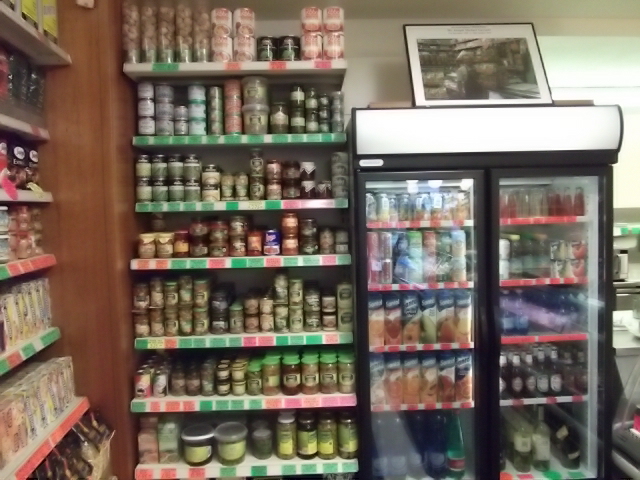 ...tins and packets - vegetables, tomatoes, pickles, mostarda,... 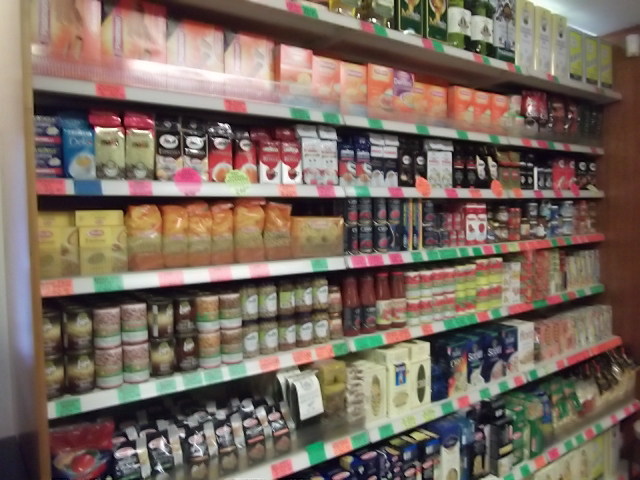 ...rice, polenta, tuna, anchovies, sardines etc. 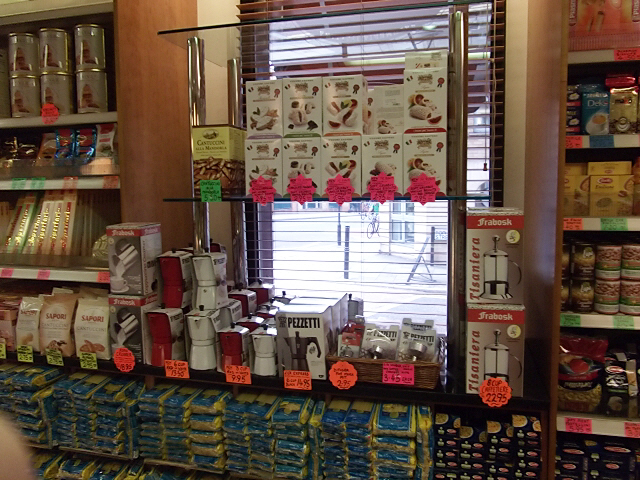 Moving down the wall, you've got your coffee makers,... 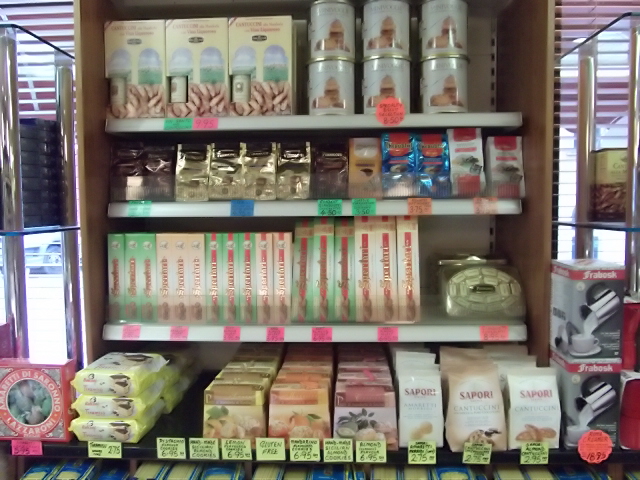 ...biscotti, cantucci,... 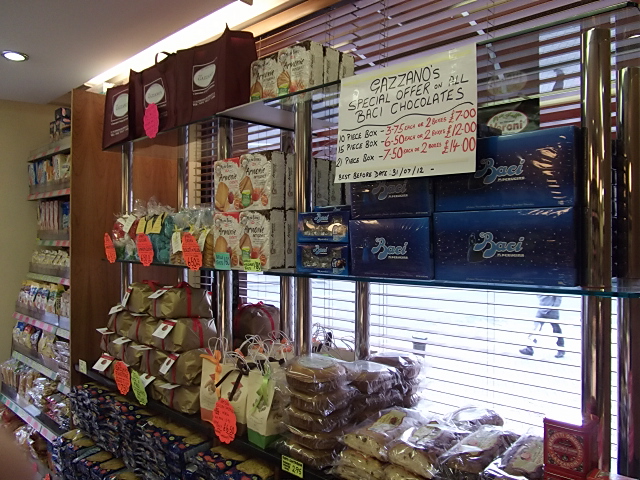 ...panettones... 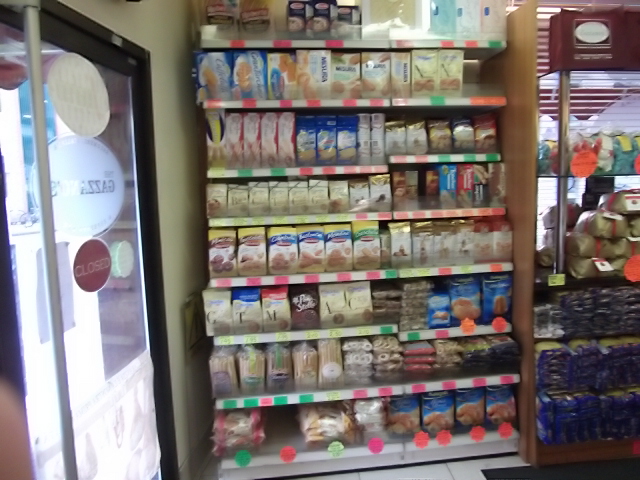 ...and cakes of various kinds (tragically, they no longer sell my favourite - Mr Day Tortina Paradiso. If anyone knows where I can get them in London, do please drop me a line). But underneath all these, running to, by my reckoning, 9 metres in length and 1 metre high, is a stunning display of dried pastas... 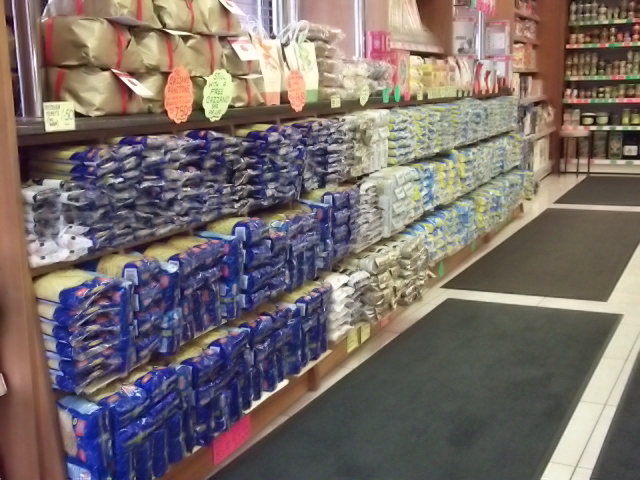 ...with many unfamilar (at least to me) names such as serpentelli, cannoroncini, gramigna coquilletes, puntallete, stellete, coralini, conchigliette piccole, rotelle and candelle lunghe. 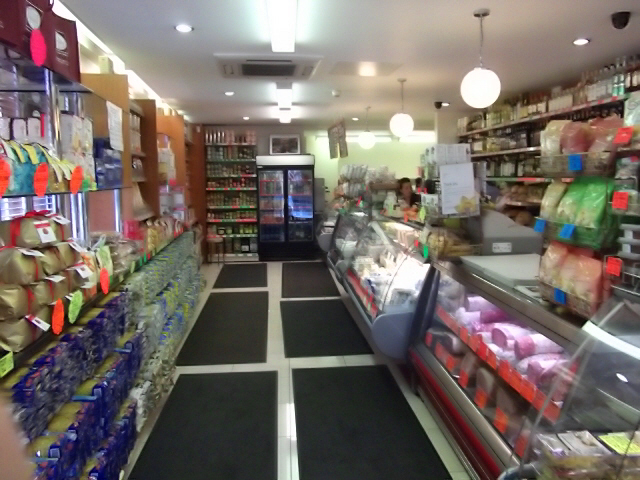 And finally, behind the counter are the breads (pugliese, casareccio, ciabatta, foccaccia), wines and oils. You'll have probably gathered by now that I love this place (the post title being something of a giveaway). You'd think that what is essentially a simple concept - choose the food of a country/culture, open a shop and cram it with every product that country/culture produces - would be easily replicable. But for some reason, shops like this are all too rare. It's also rare (at least in London) to find a delicatessen where you can pick up any item, look at the price sticker and not have a voice in your head screaming 'HOW FUCKING MUCH?!?!' And, as if all of that wasn't enough, Joe, Lucy and their staff will serve you with an unassuming modesty and a kindliness which honours the much missed Joe Sr.. If food is your religion, here is where you should come to worship. The Gazzano's
167-169 Farringdon Road London EC1R 3AL Opening hours: Mon - Closed Tues - Fri 8.00 - 17.30 Sat 9.00 - 17.30 Sun 10.00 - 14.00 (Christmas open 7 days a week)
18 Comments
The Skint Foodie
1/9/2012 13:15:46
Catherine - you clocked that its over the river on Farringdon Rd, didn't you? Don't want you to come to SE15/22 for a wasted trip!
Roger McCarthy
31/8/2012 07:06:17
Wow - can't believe I worked nearby in Holborn for years and never stumbled on this place.
Jessica Baldwin
11/11/2013 15:49:46
I lived there for 10 years and have no idea where this is. Does anyone have the exact address?
The Skint Foodie
11/11/2013 21:11:31
The address is at the bottom of the post. It's a few doors up from The Eagle. The Quality Chop House is opposite.
Cathy
31/8/2012 07:09:51
I used to work about five minutes' walk from Gazzano's but, sadly, no more. But you've reminded me of how much I miss them. They also used to sell excellent fresh peaches in the summertime and make a delicious sandwich. Sigh.
Tara
31/8/2012 08:29:00
WOW - I don't live in London but when I visit I go to Peckham to visit Persopolis - last time I didn't get a no 63 - next time I'm changing buses and making a lengthy stopover!
The Skint Foodie
1/9/2012 13:21:01
Hope you get there one day soon. :0)
acpgee
1/9/2012 02:01:15
Thanks for the tip. I live pretty close by and had never heard of it.
Natalie
1/9/2012 02:11:38
PLEASE tell me they sell pan di stelle cookies? Im visiting London in a couple of days and would really like to stock up!
Simona
1/9/2012 04:09:05
They do!
The Skint Foodie
2/9/2012 12:57:11
I have been to Gennaro's a year or so back - can't think why I've not returned. Although Gazzano's is actually a little bit easier for me to get to via bus. Especially as the bus stop is almost right outside their door.
Kate
3/9/2012 03:43:59
Wish to god I was closer!!! Even 3hrs away from my Scottish/Italian heaven Valvona & Crolla in Edinburgh!!
Catherine
8/9/2012 05:24:12
Just seen your comment to me! ha ha, yes, I had noticed, I meant that I can still get that bus! :)
Michael
26/9/2012 23:02:05
I live just around the corner from this place and you are absolutely right, it is just like being transported to Italy. I believe the even import some vegetables from Italy and have those excellent mildly salted San Carlo crisps that take me back to Tuscan holidays.
The Skint Foodie
26/9/2012 23:54:48
Ooh, I've not tried the San Carlo crisps, I'll give them a go - thanks! Your comment will be posted after it is approved.
Leave a Reply. |

SHORTLISTED FOR FOOD BLOG OF THE YEAR 2014
follow/subscribe:
   blog archives:
November 2014
|
